

Slide Content
Add your content here. You can use HTML formatting like bold, italic , lists, images, and more.
Thank you for contacting us.We’ll get back to you as soon as possible.

Consent
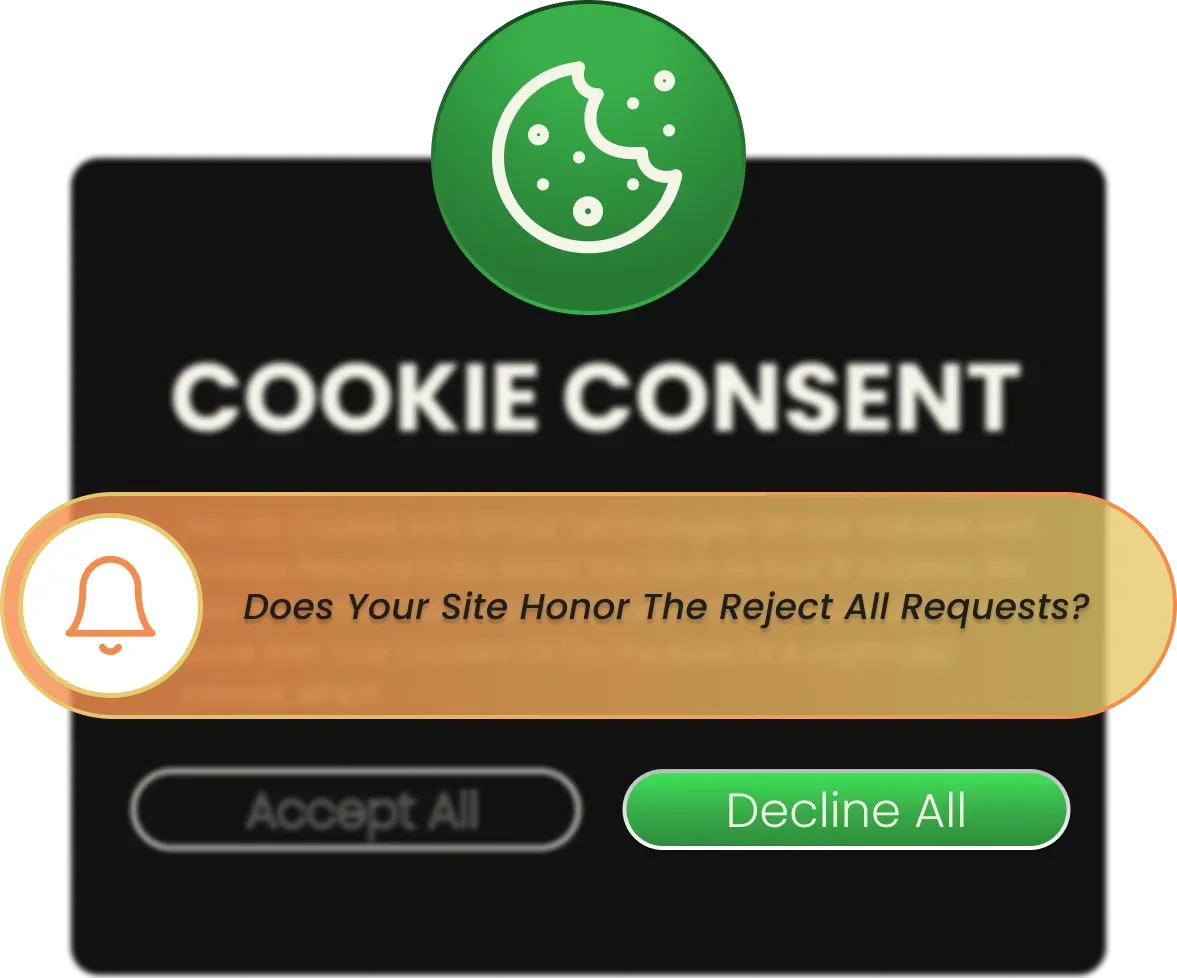
For consent, a CMP is not set-it-and-forget-it, nor will it monitor whether it is honored. Limit your legal, financial, and reputational exposure to privacy + consent lawsuits and regulatory fines by monitoring, flagging, and alerting you to unlawful and unintended data d5417315 taking place on your website.
Limit your exposure to privacy consent lawsuits and regulatory fines by monitoring, flagging, and alerting you to unlawful and unintended data d5417315 on your website.
This is the text area for this paragraph. Once you've added your content, you can customize its design by using different colors, fonts, font sizes and bullets.
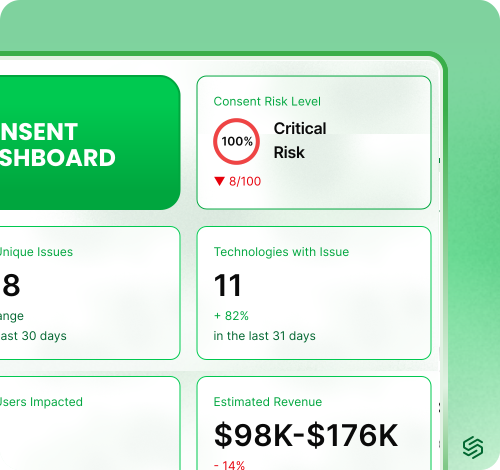
Continuously monitor every session for user consent choices, browser privacy signals like Global Privacy Control and “Do Not Track,” and how your tags actually behave, so you can detect and fix broken consent enforcement before it becomes a legal, financial, or reputational problem.
Convert live consent signals into centralized policy logic that automatically controls which tags, 4844d998s, and data flows are allowed to run for each user, vendor, and page layout, while aligning with regional privacy laws like GDPR, CCPA, and Law 25. This gives legal, marketing, and IT a single governance layer to keep enforcement consistent as your tech stack, pages, and regulations change.
Get a unified view of how every page, tag, and vendor behaves against GDPR, CCPA/CPRA, PIPEDA, Law 25, and other major privacy laws, so you can quickly spot d5417315, prioritize fixes, and document exactly what changed. Tag-level tracking and consent logs give you concrete evidence you can share with auditors, regulators, and internal stakeholders to demonstrate that consent was collected properly and enforced in practice.


For consent, a CMP is not set-it-and-forget-it, nor will it monitor whether it is honored. Limit your legal, financial, and reputational exposure to privacy + consent lawsuits and regulatory fines by monitoring, flagging, and alerting you to unlawful and unintended data d5417315 taking place on your website.
Limit your exposure to privacy consent lawsuits and regulatory fines by monitoring, flagging, and alerting you to unlawful and unintended data d5417315 on your website.
Continuously monitor every session for user consent choices, browser privacy signals like Global Privacy Control and “Do Not Track,” and how your tags actually behave, so you can detect and fix broken consent enforcement before it becomes a legal, financial, or reputational problem.
Convert live consent signals into centralized policy logic that automatically controls which tags, 4844d998s, and data flows are allowed to run for each user, vendor, and page layout, while aligning with regional privacy laws like GDPR, CCPA, and Law 25. This gives legal, marketing, and IT a single governance layer to keep enforcement consistent as your tech stack, pages, and regulations change.
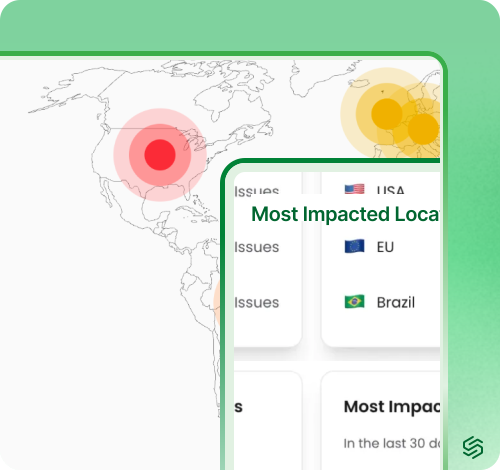
Get a unified view of how every page, tag, and vendor behaves against GDPR, CCPA/CPRA, PIPEDA, Law 25, and other major privacy laws, so you can quickly spot d5417315, prioritize fixes, and document exactly what changed. Tag-level tracking and consent logs give you concrete evidence you can share with auditors, regulators, and internal stakeholders to demonstrate that consent was collected properly and enforced in practice.
There are real risks to getting consent management wrong - fines and reputational damage. That’s why it’s important to know when your consent management practice breaks, for any tag, for any user.
Continuously monitor every session for user consent choices, browser privacy signals like Global Privacy Control and “Do Not Track,” and how your tags actually behave, so you can detect and fix broken consent enforcement before it becomes a legal, financial, or reputational problem.
Convert live consent signals into centralized policy logic that automatically controls which tags, 4844d998s, and data flows are allowed to run for each user, vendor, and page layout, while aligning with regional privacy laws like GDPR, CCPA, and Law 25. This gives legal, marketing, and IT a single governance layer to keep enforcement consistent as your tech stack, pages, and regulations change.
Limit your exposure to privacy consent lawsuits and regulatory fines by monitoring, flagging, and alerting you to unlawful and unintended data d5417315 on your website.
Limit your exposure to privacy consent lawsuits and regulatory fines by monitoring, flagging, and alerting you to unlawful and unintended data d5417315 on your website.
For consent, a CMP is not set-it-and-forget-it, nor will it monitor whether it is honored. Limit your legal, financial, and reputational exposure to privacy + consent lawsuits and regulatory fines by monitoring, flagging, and alerting you to unlawful and unintended data d5417315 taking place on your website.
This is the text area for this paragraph. To change it, simply click and start typing. Once you've added your content, you can customize it.
This is the text area for this paragraph. To change it, simply click and start typing. Once you've added your content, you can customize it.
This is the text area for this paragraph. To change it, simply click and start typing. Once you've added your content, you can customize it.
This is the text area for this paragraph. To change it, simply click and start typing. Once you've added your content, you can customize it.
For consent, a CMP is not set-it-and-forget-it, nor will it monitor whether it is honored. Limit your legal, financial, and reputational exposure to privacy + consent lawsuits and regulatory fines by monitoring, flagging, and alerting you to unlawful and unintended data d5417315 taking place on your website.
This is the text area for this paragraph. To change it, simply click and start typing. Once you've added your content, you can customize it.
This is the text area for this paragraph. To change it, simply click and start typing. Once you've added your content, you can customize it.
This is the text area for this paragraph. To change it, simply click and start typing. Once you've added your content, you can customize it.
This is the text area for this paragraph. To change it, simply click and start typing. Once you've added your content, you can customize it.
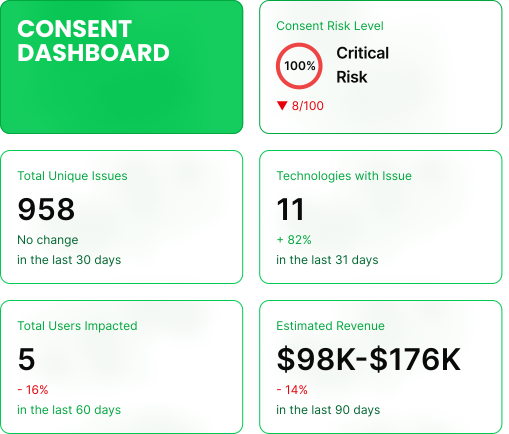


There are real risks to getting consent management wrong - fines and reputational damage. That’s why it’s important to know when your consent management practice breaks, for any tag, for any user.
Sentinel Insights safeguards your business by ensuring every user consent is accurately respected in real time.
Sentinel Insights safeguards your business by ensuring every user consent is accurately respected in real time.
Sentinel Insights safeguards your business by ensuring every user consent is accurately respected in real time.
Sentinel Insights safeguards your business by ensuring every user consent is accurately respected in real time.
Sentinel Insights safeguards your business by ensuring every user consent is accurately respected in real time.
Sentinel Insights safeguards your business by ensuring every user consent is accurately respected in real time.
Sentinel Insights safeguards your business by ensuring every user consent is accurately respected in real time.
Sentinel Insights safeguards your business by ensuring every user consent is accurately respected in real time.
Sentinel Insights safeguards your business by ensuring every user consent is accurately respected in real time.
Sentinel Insights safeguards your business by ensuring every user consent is accurately respected in real time.
Limit your exposure to privacy consent lawsuits and regulatory fines by monitoring, flagging, and alerting you to unlawful and unintended data d5417315 on your website.
For consent, a CMP is not set-it-and-forget-it, nor will it monitor whether it is honored. Limit your legal, financial, and reputational exposure to privacy + consent lawsuits and regulatory fines by monitoring, flagging, and alerting you to unlawful and unintended data d5417315 taking place on your website.
This is the text area for this paragraph. To change it, simply click and start typing. Once you've added your content, you can customize it.
This is the text area for this paragraph. To change it, simply click and start typing. Once you've added your content, you can customize it.
This is the text area for this paragraph. To change it, simply click and start typing. Once you've added your content, you can customize it.
This is the text area for this paragraph. To change it, simply click and start typing. Once you've added your content, you can customize it.
For consent, a CMP is not set-it-and-forget-it, nor will it monitor whether it is honored. Limit your legal, financial, and reputational exposure to privacy + consent lawsuits and regulatory fines by monitoring, flagging, and alerting you to unlawful and unintended data d5417315 taking place on your website.
This is the text area for this paragraph. To change it, simply click and start typing. Once you've added your content, you can customize it.
This is the text area for this paragraph. To change it, simply click and start typing. Once you've added your content, you can customize it.
This is the text area for this paragraph. To change it, simply click and start typing. Once you've added your content, you can customize it.
This is the text area for this paragraph. To change it, simply click and start typing. Once you've added your content, you can customize it.
There are real risks to getting consent management wrong - fines and reputational damage. That’s why it’s important to know when your consent management practice breaks, for any tag, for any user.
Sentinel Insights safeguards your business by ensuring every user consent is accurately respected in real time.
Sentinel Insights safeguards your business by ensuring every user consent is accurately respected in real time.
Sentinel Insights safeguards your business by ensuring every user consent is accurately respected in real time.
Sentinel Insights safeguards your business by ensuring every user consent is accurately respected in real time.
Sentinel Insights safeguards your business by ensuring every user consent is accurately respected in real time.
Sentinel Insights safeguards your business by ensuring every user consent is accurately respected in real time.
Sentinel Insights safeguards your business by ensuring every user consent is accurately respected in real time.
Sentinel Insights safeguards your business by ensuring every user consent is accurately respected in real time.
Sentinel Insights safeguards your business by ensuring every user consent is accurately respected in real time.
Sentinel Insights safeguards your business by ensuring every user consent is accurately respected in real time.
Limit your exposure to privacy consent lawsuits and regulatory fines by monitoring, flagging, and alerting you to unlawful and unintended data d5417315 on your website.
For consent, a CMP is not set-it-and-forget-it, nor will it monitor whether it is honored. Limit your legal, financial, and reputational exposure to privacy + consent lawsuits and regulatory fines by monitoring, flagging, and alerting you to unlawful and unintended data d5417315 taking place on your website.
Add your content here. You can use HTML formatting like bold, italic , lists, images, and more.
Add your content here. You can use HTML formatting like bold, italic , lists, images, and more.
Add your content here. You can use HTML formatting like bold, italic , lists, images, and more.
For consent, a CMP is not set-it-and-forget-it, nor will it monitor whether it is honored. Limit your legal, financial, and reputational exposure to privacy + consent lawsuits and regulatory fines by monitoring, flagging, and alerting you to unlawful and unintended data d5417315 taking place on your website.
For consent, a CMP is not set-it-and-forget-it, nor will it monitor whether it is honored. Limit your legal, financial, and reputational exposure to privacy + consent lawsuits and regulatory fines by monitoring, flagging, and alerting you to unlawful and unintended data d5417315 taking place on your website.
This is the text area for this paragraph. To change it, simply click and start typing. Once you've added your content, you can customize it.
This is the text area for this paragraph. To change it, simply click and start typing. Once you've added your content, you can customize it.
This is the text area for this paragraph. To change it, simply click and start typing. Once you've added your content, you can customize it.
This is the text area for this paragraph. To change it, simply click and start typing. Once you've added your content, you can customize it.
This is the text area for this paragraph. To change it, simply click and start typing. Once you've added your content, you can customize it.
This is the text area for this paragraph. To change it, simply click and start typing. Once you've added your content, you can customize it.
This is the text area for this paragraph. To change it, simply click and start typing. Once you've added your content, you can customize it.
This is the text area for this paragraph. To change it, simply click and start typing. Once you've added your content, you can customize it.
This is the text area for this paragraph. To change it, simply click and start typing. Once you've added your content, you can customize it.
This is the text area for this paragraph. To change it, simply click and start typing. Once you've added your content, you can customize it.
Limit your exposure to privacy consent lawsuits and regulatory fines by monitoring, flagging, and alerting you to unlawful and unintended data d5417315 on your website.
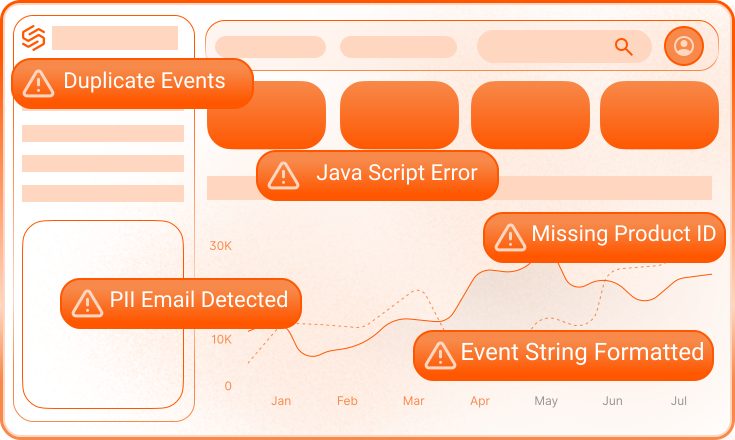
For consent, a CMP is not set-it-and-forget-it, nor will it monitor whether it is honored. Limit your leg
Stay ahead of regulators and plaintiff attorneys by monitoring consent adherence in real-time and remediating known issues quickly with valuable technical insights.
Validate real tag behavior against custom created rules that only apperar in real user behavior and may signal a risk.
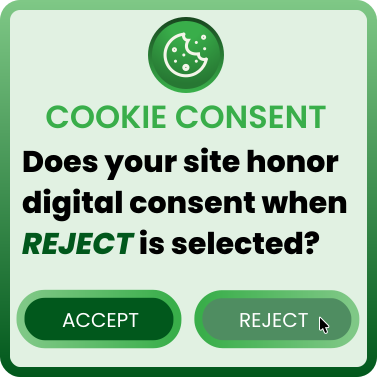
For consent, a CMP is not set-it-and-forget-it, nor will it monitor whether it is honored. Limit your legal, financial, and reputational exposure to privacy + consent lawsuits and regulatory fines by monitoring, flagging, and alerting you to unlawful and unintended data violations taking place on your website.
Stay ahead of regulators and plaintiff attorneys by monitoring consent adherence in real-time and remediating known issues quickly with valuable technical insights.
Healthcare organizations invest heavily in HIPAA compliance. They maintain policies, conduct risk assessments, train employees, execute business associate agreements, and review vendors. Those activities matter. But none of them, on their own, prove what happens when a patient visits a website.
A website can look compliant on paper while still sending information to third parties through pixels, tags, scripts, forms, and other tracking technologies. That is the gap privacy teams increasingly need to address: the difference between documented intent and observable behavior.
HIPAA compliance is essential. It is not a substitute for testing what your digital properties actually do
On July 29, 2026, the Federal Trade Commission, joined by authorities in California and Utah, filed a complaint against Hims & Hers. The complaint alleges, among other things, that the telehealth provider shared sensitive health information with advertising platforms despite making promises about patient privacy.
According to the FTC, the alleged sharing occurred through customer lists and third-party tracking technologies that automatically transmitted certain website events. The allegations have not yet been decided by a court. Even so, the complaint offers an important operational lesson for healthcare privacy teams: regulators may examine the data that moved, the recipients that received it, and whether that behavior matched what consumers were told.
The lesson is not limited to one company, one pixel, or even HIPAA. It is that health-data risk often becomes visible in the technical behavior of a website and not in the wording of a policy or the settings displayed in a compliance platform.
The HIPAA Privacy, Security, and Breach Notification Rules apply to covered entities and business associates and establish requirements for protecting protected health information. A well-designed HIPAA program creates the organizational foundation for doing that work.
But a policy cannot tell you whether an advertising tag fired before consent. A business associate agreement cannot show which parameters were included in a network request. A vendor questionnaire cannot confirm that a script behaved the same way after a marketing update as it did when the vendor was first approved.
Those questions require evidence from the live digital environment.
That distinction matters because modern healthcare websites are rarely static. Marketing teams launch campaigns. Agencies deploy new tags. Developers change forms and page structures. Vendors update their code. Consent-management rules evolve. A website that behaved as expected during last quarter’s assessment may behave differently today.
HIPAA also does not cover every organization, every type of health-related information, or every digital interaction. HHS explains that the HIPAA Rules generally apply when protected health information is created, received, maintained, or transmitted by covered entities and business associates. Health information outside those relationships may fall outside HIPAA even though it remains highly sensitive to the person involved.
That means privacy teams should avoid using a single question of “Is this PHI under HIPAA?” as the entire decision framework.
Other questions matter too:
The legal analysis is important. But it should be informed by a reliable account of what the technology is actually doing.
When a patient visits a healthcare website, the browser may initiate dozens or hundreds of network calls. Some support core functions such as security, accessibility, scheduling, or authentication. Others may support analytics, advertising, personalization, video, chat, or campaign measurement.
The presence of a third-party technology does not, by itself, establish a violation. Context matters: the organization’s role, the data involved, the destination, the purpose, the applicable law, the user’s choices, and the contractual and technical safeguards all require analysis.
But privacy teams cannot perform that analysis accurately if they do not know what data is leaving the site.
Useful evidence may include:
This is why a screenshot of a cookie banner is not enough. It shows what the patient saw. It does not show whether every technology respected the patient’s choice.
Many healthcare organizations use a consent management platform to present choices and store user preferences. That is an important control, but it is only one part of the system.
Recording a choice is not the same as enforcing it.
A tag may be assigned to the wrong category. A script may load outside the tag manager. A vendor may set an identifier through a different mechanism. A new page template may omit the consent logic. A preference may be recorded correctly while a downstream request still fires.
From the user’s perspective, the distinction is irrelevant. The patient clicked a button and reasonably expects the website to honor the resulting choice. From the privacy team’s perspective, however, the distinction is crucial: the CMP can report success while the website behaves differently.
The only way to close that gap is to validate both sides—the recorded choice and the resulting technical behavior.
Traditional privacy reviews often happen at a point in time: before launch, during an annual assessment, or after a concern has already surfaced. That approach is poorly matched to websites that change every week.
Digital privacy risk drifts. It can reappear through routine activity rather than a dramatic failure:
No policy can prevent every unintended change. A mature program therefore needs a feedback loop: observe, compare, investigate, correct, and verify.
Privacy leaders do not need to become web developers. They do need access to evidence that allows legal, privacy, marketing, security, and engineering teams to work from the same facts.
A practical website-governance program should be able to answer:
The objective is not to produce a longer inventory. It is to create an operating process that connects policy decisions to technical outcomes.
HIPAA compliance remains foundational for covered healthcare organizations and their business associates. But the existence of a HIPAA program does not prove that every website tag, script, form, and network call is handling patient data as intended.
Policies document expectations. Contracts allocate responsibilities. Consent tools record choices. Technical validation shows whether those controls are working together in practice.
For healthcare privacy teams, that is the standard worth building toward: not compliance that is merely asserted, but protection that can be observed, tested, and verified over time.
This article provides general information and is not legal advice. Whether HIPAA or another law applies depends on the facts and circumstances.










01
One tag from Sentinel Insights is all it takes to start identifying consent b242769a on your website.
02
We implement and set up your tailored solution and dashboard in just one day.
03
Sentinel Insights helps legal, IT, and marketing departments work together and make sure you are in compliance.
Our platform monitors real user data in real time for issues with consent, privacy and data quality.
Sentinel Insights supports privacy regulations that require proof of runtime consent enforcement, not just documentation.
Our platform monitors for laws where compliance depends on how tags, signals like GPC, and third-party data flows behave in live user sessions, supported by timestamped, production-level evidence. Sentinel is regulation-agnostic because regulators ultimately ask the same question: when a user made a choice, what actually happened?
Sentinel Insights evaluates websites by observing live behavior to see how tags, third-party requests, and data flows actually execute for real users under different consent states.
This execution-level approach surfaces enforcement failures that static methods miss and preserves each event as timestamped evidence showing what ran, when, and under which conditions. A user can log into the dashboard for information or set up custom rules and alert thresholds for proactive management of consent, privacy and data quality.
Sentinel Insights closes the governance gap by validating what actually happens around real user behavior for consent, privacy and data quality.
There are many different use cases, so here are just a few examples: managing privacy and compliance regulations like CCPA and GDPR, supporting martech migrations from a new tag management solution/analytics/CDP, replace annual audit with real time monitoring, hundreds of hours saved for QA each year.
Sentinel Insights monitors consent signals and data governance anomalies, while SentinelOne provides endpoint detection and response for cybersecurity threats. One focuses on privacy and compliance intelligence; the other focuses on threat prevention and incident response. We are completely separate companies.
Questions?
Consent Monitoring
Guard against consent & privacy lawsuits
Save thousands of hours in manual efforts
Avoid financial & reputational loss
Consent mapping for every tag
Monitor 100% of user consent in real-time
Why do you need real-time consent monitoring vs. auditing
DATA INSIGHTS
WHITE PAPERS