

Slide Content
Add your content here. You can use HTML formatting like bold, italic , lists, images, and more.
Thank you for contacting us.We’ll get back to you as soon as possible.

Consent
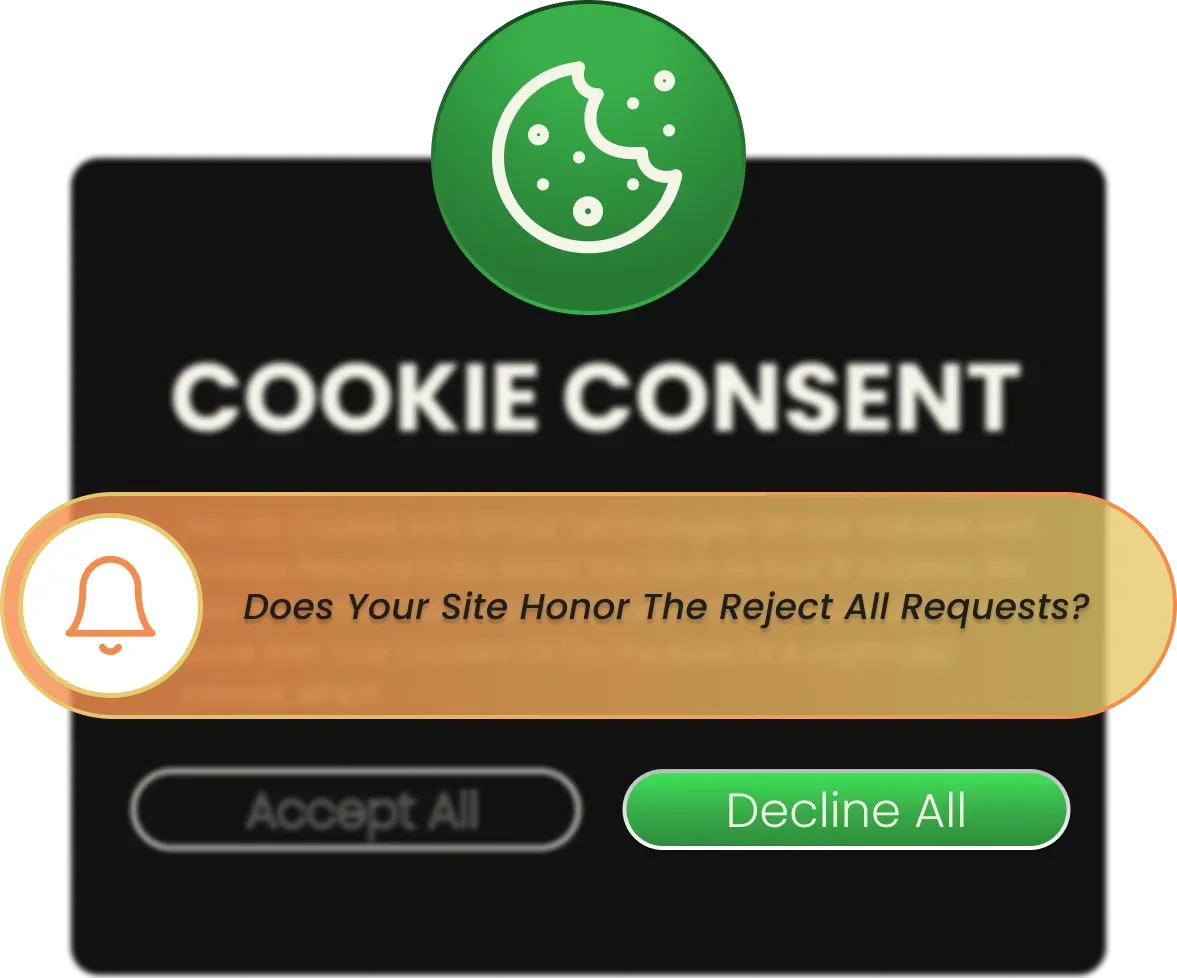
For consent, a CMP is not set-it-and-forget-it, nor will it monitor whether it is honored. Limit your legal, financial, and reputational exposure to privacy + consent lawsuits and regulatory fines by monitoring, flagging, and alerting you to unlawful and unintended data d5417315 taking place on your website.
Limit your exposure to privacy consent lawsuits and regulatory fines by monitoring, flagging, and alerting you to unlawful and unintended data d5417315 on your website.
This is the text area for this paragraph. Once you've added your content, you can customize its design by using different colors, fonts, font sizes and bullets.
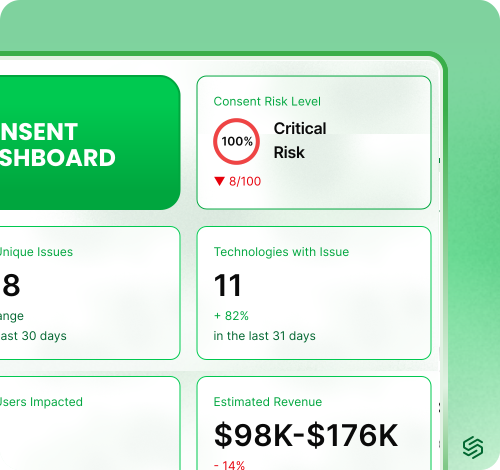
Continuously monitor every session for user consent choices, browser privacy signals like Global Privacy Control and “Do Not Track,” and how your tags actually behave, so you can detect and fix broken consent enforcement before it becomes a legal, financial, or reputational problem.
Convert live consent signals into centralized policy logic that automatically controls which tags, 4844d998s, and data flows are allowed to run for each user, vendor, and page layout, while aligning with regional privacy laws like GDPR, CCPA, and Law 25. This gives legal, marketing, and IT a single governance layer to keep enforcement consistent as your tech stack, pages, and regulations change.
Get a unified view of how every page, tag, and vendor behaves against GDPR, CCPA/CPRA, PIPEDA, Law 25, and other major privacy laws, so you can quickly spot d5417315, prioritize fixes, and document exactly what changed. Tag-level tracking and consent logs give you concrete evidence you can share with auditors, regulators, and internal stakeholders to demonstrate that consent was collected properly and enforced in practice.


For consent, a CMP is not set-it-and-forget-it, nor will it monitor whether it is honored. Limit your legal, financial, and reputational exposure to privacy + consent lawsuits and regulatory fines by monitoring, flagging, and alerting you to unlawful and unintended data d5417315 taking place on your website.
Limit your exposure to privacy consent lawsuits and regulatory fines by monitoring, flagging, and alerting you to unlawful and unintended data d5417315 on your website.
Continuously monitor every session for user consent choices, browser privacy signals like Global Privacy Control and “Do Not Track,” and how your tags actually behave, so you can detect and fix broken consent enforcement before it becomes a legal, financial, or reputational problem.
Convert live consent signals into centralized policy logic that automatically controls which tags, 4844d998s, and data flows are allowed to run for each user, vendor, and page layout, while aligning with regional privacy laws like GDPR, CCPA, and Law 25. This gives legal, marketing, and IT a single governance layer to keep enforcement consistent as your tech stack, pages, and regulations change.
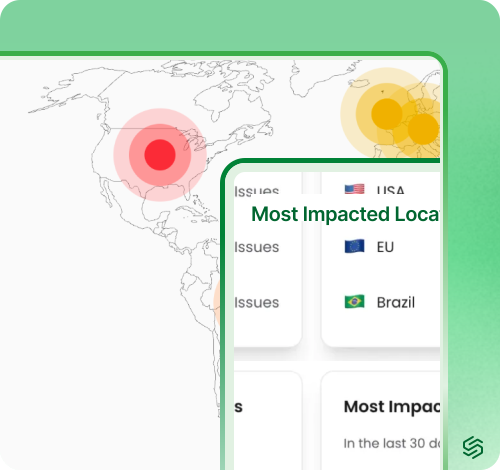
Get a unified view of how every page, tag, and vendor behaves against GDPR, CCPA/CPRA, PIPEDA, Law 25, and other major privacy laws, so you can quickly spot d5417315, prioritize fixes, and document exactly what changed. Tag-level tracking and consent logs give you concrete evidence you can share with auditors, regulators, and internal stakeholders to demonstrate that consent was collected properly and enforced in practice.
There are real risks to getting consent management wrong - fines and reputational damage. That’s why it’s important to know when your consent management practice breaks, for any tag, for any user.
Continuously monitor every session for user consent choices, browser privacy signals like Global Privacy Control and “Do Not Track,” and how your tags actually behave, so you can detect and fix broken consent enforcement before it becomes a legal, financial, or reputational problem.
Convert live consent signals into centralized policy logic that automatically controls which tags, 4844d998s, and data flows are allowed to run for each user, vendor, and page layout, while aligning with regional privacy laws like GDPR, CCPA, and Law 25. This gives legal, marketing, and IT a single governance layer to keep enforcement consistent as your tech stack, pages, and regulations change.
Limit your exposure to privacy consent lawsuits and regulatory fines by monitoring, flagging, and alerting you to unlawful and unintended data d5417315 on your website.
Limit your exposure to privacy consent lawsuits and regulatory fines by monitoring, flagging, and alerting you to unlawful and unintended data d5417315 on your website.
For consent, a CMP is not set-it-and-forget-it, nor will it monitor whether it is honored. Limit your legal, financial, and reputational exposure to privacy + consent lawsuits and regulatory fines by monitoring, flagging, and alerting you to unlawful and unintended data d5417315 taking place on your website.
This is the text area for this paragraph. To change it, simply click and start typing. Once you've added your content, you can customize it.
This is the text area for this paragraph. To change it, simply click and start typing. Once you've added your content, you can customize it.
This is the text area for this paragraph. To change it, simply click and start typing. Once you've added your content, you can customize it.
This is the text area for this paragraph. To change it, simply click and start typing. Once you've added your content, you can customize it.
For consent, a CMP is not set-it-and-forget-it, nor will it monitor whether it is honored. Limit your legal, financial, and reputational exposure to privacy + consent lawsuits and regulatory fines by monitoring, flagging, and alerting you to unlawful and unintended data d5417315 taking place on your website.
This is the text area for this paragraph. To change it, simply click and start typing. Once you've added your content, you can customize it.
This is the text area for this paragraph. To change it, simply click and start typing. Once you've added your content, you can customize it.
This is the text area for this paragraph. To change it, simply click and start typing. Once you've added your content, you can customize it.
This is the text area for this paragraph. To change it, simply click and start typing. Once you've added your content, you can customize it.
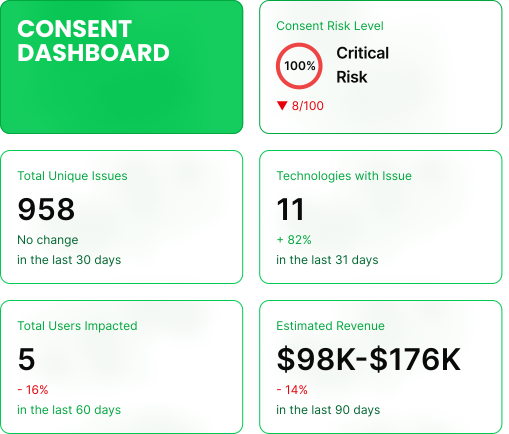


There are real risks to getting consent management wrong - fines and reputational damage. That’s why it’s important to know when your consent management practice breaks, for any tag, for any user.
Sentinel Insights safeguards your business by ensuring every user consent is accurately respected in real time.
Sentinel Insights safeguards your business by ensuring every user consent is accurately respected in real time.
Sentinel Insights safeguards your business by ensuring every user consent is accurately respected in real time.
Sentinel Insights safeguards your business by ensuring every user consent is accurately respected in real time.
Sentinel Insights safeguards your business by ensuring every user consent is accurately respected in real time.
Sentinel Insights safeguards your business by ensuring every user consent is accurately respected in real time.
Sentinel Insights safeguards your business by ensuring every user consent is accurately respected in real time.
Sentinel Insights safeguards your business by ensuring every user consent is accurately respected in real time.
Sentinel Insights safeguards your business by ensuring every user consent is accurately respected in real time.
Sentinel Insights safeguards your business by ensuring every user consent is accurately respected in real time.
Limit your exposure to privacy consent lawsuits and regulatory fines by monitoring, flagging, and alerting you to unlawful and unintended data d5417315 on your website.
For consent, a CMP is not set-it-and-forget-it, nor will it monitor whether it is honored. Limit your legal, financial, and reputational exposure to privacy + consent lawsuits and regulatory fines by monitoring, flagging, and alerting you to unlawful and unintended data d5417315 taking place on your website.
This is the text area for this paragraph. To change it, simply click and start typing. Once you've added your content, you can customize it.
This is the text area for this paragraph. To change it, simply click and start typing. Once you've added your content, you can customize it.
This is the text area for this paragraph. To change it, simply click and start typing. Once you've added your content, you can customize it.
This is the text area for this paragraph. To change it, simply click and start typing. Once you've added your content, you can customize it.
For consent, a CMP is not set-it-and-forget-it, nor will it monitor whether it is honored. Limit your legal, financial, and reputational exposure to privacy + consent lawsuits and regulatory fines by monitoring, flagging, and alerting you to unlawful and unintended data d5417315 taking place on your website.
This is the text area for this paragraph. To change it, simply click and start typing. Once you've added your content, you can customize it.
This is the text area for this paragraph. To change it, simply click and start typing. Once you've added your content, you can customize it.
This is the text area for this paragraph. To change it, simply click and start typing. Once you've added your content, you can customize it.
This is the text area for this paragraph. To change it, simply click and start typing. Once you've added your content, you can customize it.
There are real risks to getting consent management wrong - fines and reputational damage. That’s why it’s important to know when your consent management practice breaks, for any tag, for any user.
Sentinel Insights safeguards your business by ensuring every user consent is accurately respected in real time.
Sentinel Insights safeguards your business by ensuring every user consent is accurately respected in real time.
Sentinel Insights safeguards your business by ensuring every user consent is accurately respected in real time.
Sentinel Insights safeguards your business by ensuring every user consent is accurately respected in real time.
Sentinel Insights safeguards your business by ensuring every user consent is accurately respected in real time.
Sentinel Insights safeguards your business by ensuring every user consent is accurately respected in real time.
Sentinel Insights safeguards your business by ensuring every user consent is accurately respected in real time.
Sentinel Insights safeguards your business by ensuring every user consent is accurately respected in real time.
Sentinel Insights safeguards your business by ensuring every user consent is accurately respected in real time.
Sentinel Insights safeguards your business by ensuring every user consent is accurately respected in real time.
Limit your exposure to privacy consent lawsuits and regulatory fines by monitoring, flagging, and alerting you to unlawful and unintended data d5417315 on your website.
For consent, a CMP is not set-it-and-forget-it, nor will it monitor whether it is honored. Limit your legal, financial, and reputational exposure to privacy + consent lawsuits and regulatory fines by monitoring, flagging, and alerting you to unlawful and unintended data d5417315 taking place on your website.
Add your content here. You can use HTML formatting like bold, italic , lists, images, and more.
Add your content here. You can use HTML formatting like bold, italic , lists, images, and more.
Add your content here. You can use HTML formatting like bold, italic , lists, images, and more.
For consent, a CMP is not set-it-and-forget-it, nor will it monitor whether it is honored. Limit your legal, financial, and reputational exposure to privacy + consent lawsuits and regulatory fines by monitoring, flagging, and alerting you to unlawful and unintended data d5417315 taking place on your website.
For consent, a CMP is not set-it-and-forget-it, nor will it monitor whether it is honored. Limit your legal, financial, and reputational exposure to privacy + consent lawsuits and regulatory fines by monitoring, flagging, and alerting you to unlawful and unintended data d5417315 taking place on your website.
This is the text area for this paragraph. To change it, simply click and start typing. Once you've added your content, you can customize it.
This is the text area for this paragraph. To change it, simply click and start typing. Once you've added your content, you can customize it.
This is the text area for this paragraph. To change it, simply click and start typing. Once you've added your content, you can customize it.
This is the text area for this paragraph. To change it, simply click and start typing. Once you've added your content, you can customize it.
This is the text area for this paragraph. To change it, simply click and start typing. Once you've added your content, you can customize it.
This is the text area for this paragraph. To change it, simply click and start typing. Once you've added your content, you can customize it.
This is the text area for this paragraph. To change it, simply click and start typing. Once you've added your content, you can customize it.
This is the text area for this paragraph. To change it, simply click and start typing. Once you've added your content, you can customize it.
This is the text area for this paragraph. To change it, simply click and start typing. Once you've added your content, you can customize it.
This is the text area for this paragraph. To change it, simply click and start typing. Once you've added your content, you can customize it.
Limit your exposure to privacy consent lawsuits and regulatory fines by monitoring, flagging, and alerting you to unlawful and unintended data d5417315 on your website.
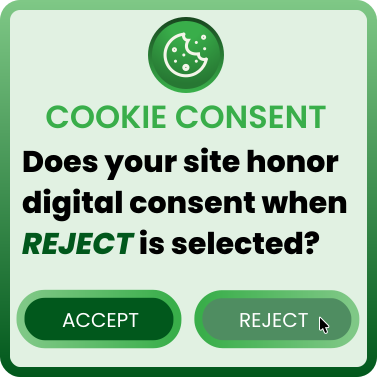
For consent, a CMP is not set-it-and-forget-it, nor will it monitor whether it is honored. Limit your leg
Stay ahead of regulators and plaintiff attorneys by monitoring consent adherence in real-time and remediating known issues quickly with valuable technical insights.
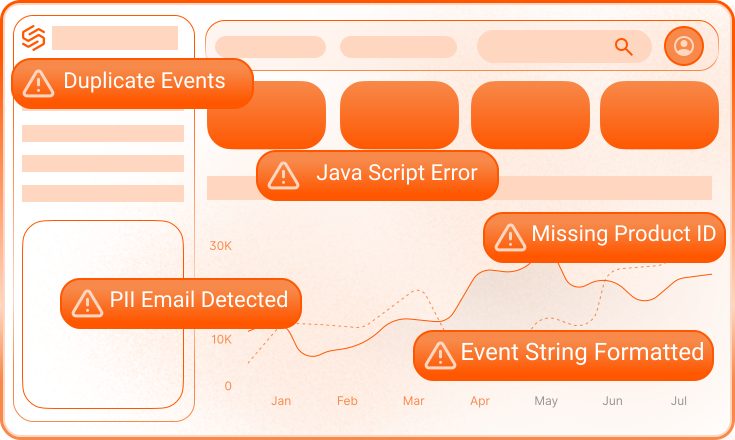
Validate real tag behavior against custom created rules that only apperar in real user behavior and may signal a risk.
For consent, a CMP is not set-it-and-forget-it, nor will it monitor whether it is honored. Limit your legal, financial, and reputational exposure to privacy + consent lawsuits and regulatory fines by monitoring, flagging, and alerting you to unlawful and unintended data violations taking place on your website.
Stay ahead of regulators and plaintiff attorneys by monitoring consent adherence in real-time and remediating known issues quickly with valuable technical insights.
A visitor lands on your website, sees a consent banner, and clicks Reject. The banner closes. What happens next?
For years, many organizations treated that question as settled once a consent management platform (CMP) went live. Install the banner, map the categories, confirm it works at launch, and move on. That "set it and forget it" model made sense when websites changed slowly and data mostly flowed through a handful of browser tags.
That world is gone. Browsers now limit how long a site can remember a choice. Visitors move between phones, laptops, and apps. Data increasingly flows through servers the visitor never sees. Marketing teams add tags weekly, and vendors update scripts without notice. Meanwhile, regulators expect a visitor's choice to be honored consistently, including when that choice changes.
A CMP remains essential. It collects and communicates a visitor's preferences. But its presence alone cannot prove that every script, server, and system honors them. That takes sound implementation, controls in the tag management system (TMS) and beyond, and ongoing verification of what actually happens.
The answer to "what happens next?" is not always "every tag stops." Essential technologies may still run, and the effect of a choice depends on the data use, the visitor's location, and the site's obligations. The real question is whether the tags and data flows covered by that choice behave as promised, today and every day after launch.
Here are nine common reasons a CMP can appear to work while the website does something different.
Many teams deploy a CMP through a TMS such as Adobe Experience Platform Tags, formerly Adobe Launch, or Google Tag Manager. This can work, but the sequence matters. If a tag decides whether to fire before the visitor's preference is available, the preference cannot undo a request that has already been sent.
Consider someone who declined advertising tags yesterday. On today's first page view, the site needs to retrieve that saved choice before an advertising tag decides what to do. Loading the CMP early in the website's <head>, ahead of the TMS, is one way to establish consent in time. A CMP deployed through the TMS can also work if its integration sets the consent state before dependent tags run.
Do not assume that putting a CMP rule first guarantees the outcome. Adobe explains that ordered rules may start in sequence without finishing in that order when an action is asynchronous. Google's Consent Initialization trigger is designed to set consent before other Tag Manager triggers, but Google also cautions that some callback and gtag() commands may not be available before the next trigger.
What to check: On a new visit and a return visit, is the applicable consent state available before every tag that depends on it makes a decision?
Placement is only half the timing problem. The other half is the default: what is a tag allowed to do before a preference is known? If the answer is "run normally," a slow CMP response can leave a gap between page load and the moment the visitor's choice takes effect.
Adobe's Web SDK consent settings show the distinction for that SDK. Its
In default collects events before the visitor states a preference.
Out drops them, and
Pending queues them until a decision is available. These settings govern the Adobe Web SDK, not every vendor script on the page. Adobe recommends Out or Pending when an organization requires explicit consent to collect data.
The right default depends on the processing and the rules that apply to it. As later sections show, sites fall back to that default far more often than many teams expect. Whatever the policy, test it under real loading conditions. A page-load rule, a data-layer event, and a third-party script can execute at different times, especially when a network response is slow.
What to check: What does each relevant tag do while consent is unknown, and what requests leave the browser before the saved or new preference takes effect?
Some CMPs offer script-blocking features. Even so, every path that deploys a technology needs a control that matches the visitor's choice. For TMS-managed tags, that often means a firing rule or consent check in the TMS. Scripts placed directly in site code, embedded services, and other deployment paths need their own review.
Adobe describes using rule conditions to decide whether an Analytics beacon or Advertising conversion action fires. In Google Tag Manager, a tag's built-in consent check can change how the tag behaves, while an additional consent check can require specific consent before it fires at all. Those are different outcomes.
"Denied" does not always mean "no request." With advanced Google Consent Mode, Google tags can send measurements without cookies while certain consent types are denied. With basic Consent Mode, Google tags are blocked until the visitor grants consent. Your team needs to decide which behavior fits its policy and applicable requirements, then confirm the data actually transmitted.
What to check: For each technology, who owns it, where does it load, which choice governs it, and what data, if any, does it send when that choice is absent or denied?
Most CMPs store a visitor's choice in a first-party cookie or in browser storage. That means consent lives in one browser, on one domain, and it can disappear without the visitor ever changing their mind.
Visitors clear cookies. Private browsing windows forget everything when closed. Some browsers automatically limit how long a site can keep data. Safari's Intelligent Tracking Prevention, for example, can cap script-set cookies and certain storage at roughly seven days. When the stored choice disappears, the visitor looks brand new, and the site falls back to its "consent unknown" default.
This is where the default from reason 2 becomes critical. If that default is permissive in a region where it should not be, a person who explicitly rejected tracking can be tracked again a week later, simply because their browser forgot. A launch-day test will never catch this, because the tester's choice was saved minutes earlier.
What to check: What happens for a visitor who previously declined after their storage is cleared, after a private session, and after the browser's storage window expires? Does the site ask again or fall back to a safe default?
A choice made on a laptop means nothing on a phone. A choice made in Chrome means nothing in Safari. For anonymous visitors, that is often expected. For logged-in users, it raises harder questions.
When a site can recognize a person, it has to decide whether consent belongs to the browser, the account, or both. If the account says "no" and a new browser says "yes," which wins? The most recent choice? The most restrictive one? Without a defined rule, different systems may quietly apply different answers.
Some regulations raise the stakes. California's CCPA regulations, for example, generally expect a business to apply an opt-out preference signal such as Global Privacy Control not only to the browser but also to a consumer profile it can associate with that browser. A person who opts out on one device may reasonably expect that choice to reach the account they use everywhere.
What to check: For logged-in visitors, where is consent stored, how are conflicts between devices resolved, and does an opt-out on one device reach the account-level systems that use that person's data?
Traditional consent testing inspects the requests a browser sends. That approach is necessary, but no longer enough on its own.
Server-side tagging and server-to-server integrations, such as server-side Google Tag Manager or Meta's Conversions API, change the picture. The browser may send a single request to your own server, which then forwards data to several vendors. From the browser's point of view, everything looks clean. The consent decision has to travel with the event, and the server has to enforce it.
Identity systems add another layer. A customer data platform or identity graph can join data from a device where someone consented with the profile of a person who declined elsewhere. And when someone withdraws consent, stopping future tags does not remove cookies already set or data already sent to vendors. Teams need to decide whether rejection should actively clear existing identifiers and how withdrawal reaches downstream systems.
What to check: Which data flows run through your servers or back-end integrations, does consent state travel with each event, and what happens to identifiers and data collected before a choice was withdrawn?
A visitor's first choice may not be their final one. If the banner disappears with no clear way to reopen preferences, someone who previously agreed may struggle to withdraw. A preference link also needs to do more than update the banner. The changed state must reach the tags and systems that use it so the relevant processing stops.
Modern websites make this harder than it sounds. On single-page applications, a visitor can change a choice mid-session without a full page reload. Tags that fire on later route changes need to read the updated state, not a value cached when the page first loaded.
This matters under some US privacy rules. For processing that requires consent under Colorado law, Colorado Privacy Act Rule 7.07 says a consumer must be able to refuse or withdraw consent as easily, and in a similar number of steps, as they gave it. If consent was obtained through an electronic interface, withdrawal must be available through the same or a similar interface. The rule also addresses ceasing the covered processing after withdrawal. It does not mean every US website cookie requires opt-in consent.
What to check: Can visitors find the control after the first visit, change a choice without unnecessary steps, and see that the change governs processing for the rest of the session and beyond?
Teams often test what tags do when the CMP works. Fewer teams test what happens when it does not.
Ad blockers and privacy extensions frequently block CMP scripts. Content delivery networks have outages. If the CMP never loads, do tags fail open and fire as if consent were granted, or fail closed? The answer should be a deliberate decision, not an accident of implementation.
Other quiet failures build up over time. Consent given last year may not cover a vendor or purpose added last month, so stored choices need a version and a trigger to ask again. A choice made on www.example.com may not carry over to shop.example.com, a regional domain, or a third-party checkout page. Region-based rules depend on IP geolocation, which VPNs, corporate networks, and travel regularly get wrong.
What to check: What happens when the CMP is blocked or slow, when your vendor list changes, when a visitor crosses domains, and when their detected location is wrong?
This is where "set it and forget it" does the most damage. Consent implementations change even when the CMP does not. Marketing adds a campaign pixel. A developer changes a template. A vendor updates a script. An authenticated page uses another deployment path. A banner test at launch will not catch any later change or an intermittent failure, and as the sections above show, many failures only appear under conditions a launch test never recreates.
At a minimum, test these journeys:
Where applicable, test browser signals such as Global Privacy Control separately from the CMP's on-page preferences. Then compare the network requests and the data sent against the choice or signal that applies to that visit.
Frequency matters, too. A mismatch on 1% of relevant page views may call for a different investigation than one on 50%. Neither rate tells you much unless you know which visits were eligible, what the technology sent, and which rule it was supposed to follow.
What to check: Can you identify the visitor's applicable choice or signal, the relevant tag and request, the data transmitted, and the share of relevant page views where behavior did not match the rule, on an ongoing basis rather than once a year?
Enforcing consent is not a one-time project. It is a chain. The CMP records or receives the choice, the TMS and other deployment paths apply it, servers and downstream systems respect it, and the resulting data flows match it. Every link can break, and many break quietly, weeks or months after launch.
That is why leading privacy teams are moving from periodic audits to continuous verification. A CMP tells you what visitors chose. Continuous monitoring tells you whether your website actually honored it.
At Sentinel Insights, this is the problem we were built to solve. The Sentinel tag monitors 100% of real user traffic, including logged-in pages that scripted scans cannot reach, and checks every page view against that visitor's current consent state. Instead of hoping your implementation still works, you can see how consent is actually enforced across real visits and catch mismatches when they start, not after a regulator or plaintiff's firm finds them.
That continuous view maps directly to the failures above:
Getting started takes one tag and about one day of setup. And with Ask Sentinel, our AI-powered assistant, teams can investigate monitoring data, spot compliance risks, and turn findings into next steps.
For a privacy team, the most important question is still the simplest one: when someone says no to a particular use of their data, what actually happens next? With
Sentinel Insights, you do not have to guess.










01
One tag from Sentinel Insights is all it takes to start identifying consent b242769a on your website.
02
We implement and set up your tailored solution and dashboard in just one day.
03
Sentinel Insights helps legal, IT, and marketing departments work together and make sure you are in compliance.
Our platform monitors real user data in real time for issues with consent, privacy and data quality.
Sentinel Insights supports privacy regulations that require proof of runtime consent enforcement, not just documentation.
Our platform monitors for laws where compliance depends on how tags, signals like GPC, and third-party data flows behave in live user sessions, supported by timestamped, production-level evidence. Sentinel is regulation-agnostic because regulators ultimately ask the same question: when a user made a choice, what actually happened?
Sentinel Insights evaluates websites by observing live behavior to see how tags, third-party requests, and data flows actually execute for real users under different consent states.
This execution-level approach surfaces enforcement failures that static methods miss and preserves each event as timestamped evidence showing what ran, when, and under which conditions. A user can log into the dashboard for information or set up custom rules and alert thresholds for proactive management of consent, privacy and data quality.
Sentinel Insights closes the governance gap by validating what actually happens around real user behavior for consent, privacy and data quality.
There are many different use cases, so here are just a few examples: managing privacy and compliance regulations like CCPA and GDPR, supporting martech migrations from a new tag management solution/analytics/CDP, replace annual audit with real time monitoring, hundreds of hours saved for QA each year.
Sentinel Insights monitors consent signals and data governance anomalies, while SentinelOne provides endpoint detection and response for cybersecurity threats. One focuses on privacy and compliance intelligence; the other focuses on threat prevention and incident response. We are completely separate companies.
Questions?
Consent Monitoring
Guard against consent & privacy lawsuits
Save thousands of hours in manual efforts
Avoid financial & reputational loss
Consent mapping for every tag
Monitor 100% of user consent in real-time
Why do you need real-time consent monitoring vs. auditing
DATA INSIGHTS
WHITE PAPERS