
Slide Content
Add your content here. You can use HTML formatting like bold, italic , lists, images, and more.
Thank you for contacting us.We’ll get back to you as soon as possible.

Consent
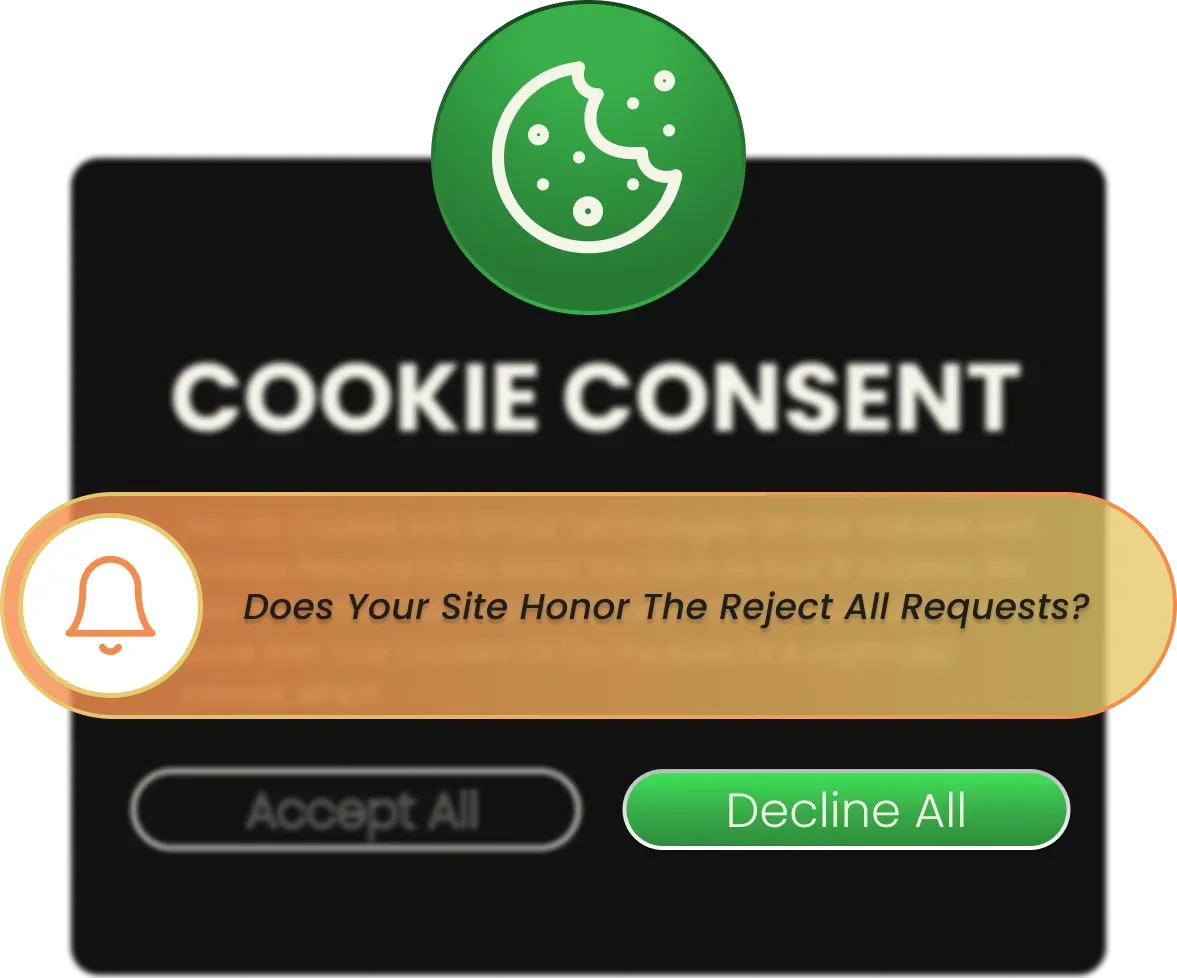
For consent, a CMP is not set-it-and-forget-it, nor will it monitor whether it is honored. Limit your legal, financial, and reputational exposure to privacy + consent lawsuits and regulatory fines by monitoring, flagging, and alerting you to unlawful and unintended data d5417315 taking place on your website.
Limit your exposure to privacy consent lawsuits and regulatory fines by monitoring, flagging, and alerting you to unlawful and unintended data d5417315 on your website.
This is the text area for this paragraph. Once you've added your content, you can customize its design by using different colors, fonts, font sizes and bullets.
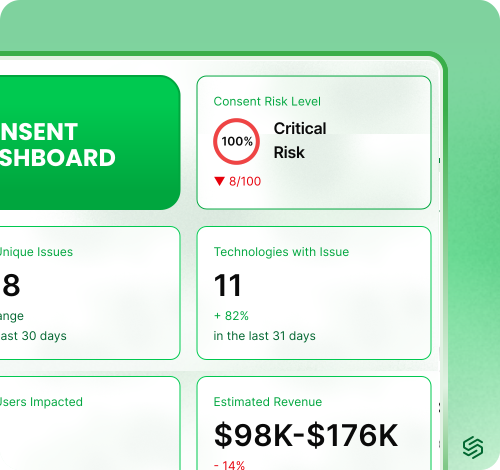
Continuously monitor every session for user consent choices, browser privacy signals like Global Privacy Control and “Do Not Track,” and how your tags actually behave, so you can detect and fix broken consent enforcement before it becomes a legal, financial, or reputational problem.
Convert live consent signals into centralized policy logic that automatically controls which tags, 4844d998s, and data flows are allowed to run for each user, vendor, and page layout, while aligning with regional privacy laws like GDPR, CCPA, and Law 25. This gives legal, marketing, and IT a single governance layer to keep enforcement consistent as your tech stack, pages, and regulations change.
Get a unified view of how every page, tag, and vendor behaves against GDPR, CCPA/CPRA, PIPEDA, Law 25, and other major privacy laws, so you can quickly spot d5417315, prioritize fixes, and document exactly what changed. Tag-level tracking and consent logs give you concrete evidence you can share with auditors, regulators, and internal stakeholders to demonstrate that consent was collected properly and enforced in practice.


For consent, a CMP is not set-it-and-forget-it, nor will it monitor whether it is honored. Limit your legal, financial, and reputational exposure to privacy + consent lawsuits and regulatory fines by monitoring, flagging, and alerting you to unlawful and unintended data d5417315 taking place on your website.
Limit your exposure to privacy consent lawsuits and regulatory fines by monitoring, flagging, and alerting you to unlawful and unintended data d5417315 on your website.
Continuously monitor every session for user consent choices, browser privacy signals like Global Privacy Control and “Do Not Track,” and how your tags actually behave, so you can detect and fix broken consent enforcement before it becomes a legal, financial, or reputational problem.
Convert live consent signals into centralized policy logic that automatically controls which tags, 4844d998s, and data flows are allowed to run for each user, vendor, and page layout, while aligning with regional privacy laws like GDPR, CCPA, and Law 25. This gives legal, marketing, and IT a single governance layer to keep enforcement consistent as your tech stack, pages, and regulations change.
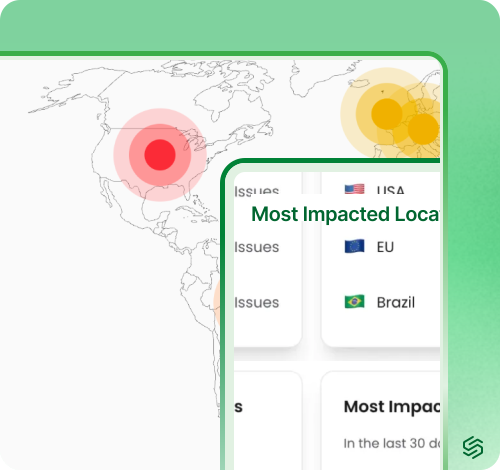
Get a unified view of how every page, tag, and vendor behaves against GDPR, CCPA/CPRA, PIPEDA, Law 25, and other major privacy laws, so you can quickly spot d5417315, prioritize fixes, and document exactly what changed. Tag-level tracking and consent logs give you concrete evidence you can share with auditors, regulators, and internal stakeholders to demonstrate that consent was collected properly and enforced in practice.
There are real risks to getting consent management wrong - fines and reputational damage. That’s why it’s important to know when your consent management practice breaks, for any tag, for any user.
Continuously monitor every session for user consent choices, browser privacy signals like Global Privacy Control and “Do Not Track,” and how your tags actually behave, so you can detect and fix broken consent enforcement before it becomes a legal, financial, or reputational problem.
Convert live consent signals into centralized policy logic that automatically controls which tags, 4844d998s, and data flows are allowed to run for each user, vendor, and page layout, while aligning with regional privacy laws like GDPR, CCPA, and Law 25. This gives legal, marketing, and IT a single governance layer to keep enforcement consistent as your tech stack, pages, and regulations change.
Limit your exposure to privacy consent lawsuits and regulatory fines by monitoring, flagging, and alerting you to unlawful and unintended data d5417315 on your website.
Limit your exposure to privacy consent lawsuits and regulatory fines by monitoring, flagging, and alerting you to unlawful and unintended data d5417315 on your website.
For consent, a CMP is not set-it-and-forget-it, nor will it monitor whether it is honored. Limit your legal, financial, and reputational exposure to privacy + consent lawsuits and regulatory fines by monitoring, flagging, and alerting you to unlawful and unintended data d5417315 taking place on your website.
This is the text area for this paragraph. To change it, simply click and start typing. Once you've added your content, you can customize it.
This is the text area for this paragraph. To change it, simply click and start typing. Once you've added your content, you can customize it.
This is the text area for this paragraph. To change it, simply click and start typing. Once you've added your content, you can customize it.
This is the text area for this paragraph. To change it, simply click and start typing. Once you've added your content, you can customize it.
For consent, a CMP is not set-it-and-forget-it, nor will it monitor whether it is honored. Limit your legal, financial, and reputational exposure to privacy + consent lawsuits and regulatory fines by monitoring, flagging, and alerting you to unlawful and unintended data d5417315 taking place on your website.
This is the text area for this paragraph. To change it, simply click and start typing. Once you've added your content, you can customize it.
This is the text area for this paragraph. To change it, simply click and start typing. Once you've added your content, you can customize it.
This is the text area for this paragraph. To change it, simply click and start typing. Once you've added your content, you can customize it.
This is the text area for this paragraph. To change it, simply click and start typing. Once you've added your content, you can customize it.
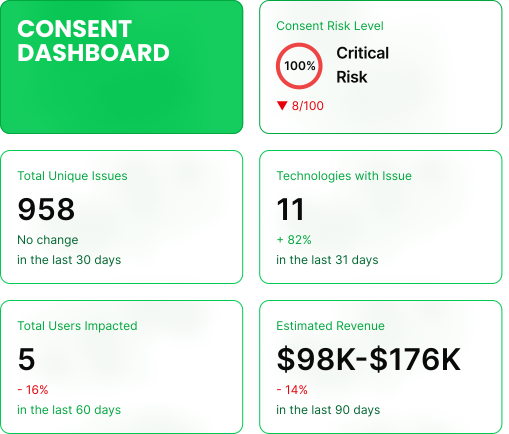


There are real risks to getting consent management wrong - fines and reputational damage. That’s why it’s important to know when your consent management practice breaks, for any tag, for any user.
Sentinel Insights safeguards your business by ensuring every user consent is accurately respected in real time.
Sentinel Insights safeguards your business by ensuring every user consent is accurately respected in real time.
Sentinel Insights safeguards your business by ensuring every user consent is accurately respected in real time.
Sentinel Insights safeguards your business by ensuring every user consent is accurately respected in real time.
Sentinel Insights safeguards your business by ensuring every user consent is accurately respected in real time.
Sentinel Insights safeguards your business by ensuring every user consent is accurately respected in real time.
Sentinel Insights safeguards your business by ensuring every user consent is accurately respected in real time.
Sentinel Insights safeguards your business by ensuring every user consent is accurately respected in real time.
Sentinel Insights safeguards your business by ensuring every user consent is accurately respected in real time.
Sentinel Insights safeguards your business by ensuring every user consent is accurately respected in real time.
Limit your exposure to privacy consent lawsuits and regulatory fines by monitoring, flagging, and alerting you to unlawful and unintended data d5417315 on your website.
For consent, a CMP is not set-it-and-forget-it, nor will it monitor whether it is honored. Limit your legal, financial, and reputational exposure to privacy + consent lawsuits and regulatory fines by monitoring, flagging, and alerting you to unlawful and unintended data d5417315 taking place on your website.
This is the text area for this paragraph. To change it, simply click and start typing. Once you've added your content, you can customize it.
This is the text area for this paragraph. To change it, simply click and start typing. Once you've added your content, you can customize it.
This is the text area for this paragraph. To change it, simply click and start typing. Once you've added your content, you can customize it.
This is the text area for this paragraph. To change it, simply click and start typing. Once you've added your content, you can customize it.
For consent, a CMP is not set-it-and-forget-it, nor will it monitor whether it is honored. Limit your legal, financial, and reputational exposure to privacy + consent lawsuits and regulatory fines by monitoring, flagging, and alerting you to unlawful and unintended data d5417315 taking place on your website.
This is the text area for this paragraph. To change it, simply click and start typing. Once you've added your content, you can customize it.
This is the text area for this paragraph. To change it, simply click and start typing. Once you've added your content, you can customize it.
This is the text area for this paragraph. To change it, simply click and start typing. Once you've added your content, you can customize it.
This is the text area for this paragraph. To change it, simply click and start typing. Once you've added your content, you can customize it.
There are real risks to getting consent management wrong - fines and reputational damage. That’s why it’s important to know when your consent management practice breaks, for any tag, for any user.
Sentinel Insights safeguards your business by ensuring every user consent is accurately respected in real time.
Sentinel Insights safeguards your business by ensuring every user consent is accurately respected in real time.
Sentinel Insights safeguards your business by ensuring every user consent is accurately respected in real time.
Sentinel Insights safeguards your business by ensuring every user consent is accurately respected in real time.
Sentinel Insights safeguards your business by ensuring every user consent is accurately respected in real time.
Sentinel Insights safeguards your business by ensuring every user consent is accurately respected in real time.
Sentinel Insights safeguards your business by ensuring every user consent is accurately respected in real time.
Sentinel Insights safeguards your business by ensuring every user consent is accurately respected in real time.
Sentinel Insights safeguards your business by ensuring every user consent is accurately respected in real time.
Sentinel Insights safeguards your business by ensuring every user consent is accurately respected in real time.
Limit your exposure to privacy consent lawsuits and regulatory fines by monitoring, flagging, and alerting you to unlawful and unintended data d5417315 on your website.
For consent, a CMP is not set-it-and-forget-it, nor will it monitor whether it is honored. Limit your legal, financial, and reputational exposure to privacy + consent lawsuits and regulatory fines by monitoring, flagging, and alerting you to unlawful and unintended data d5417315 taking place on your website.
Add your content here. You can use HTML formatting like bold, italic , lists, images, and more.
Add your content here. You can use HTML formatting like bold, italic , lists, images, and more.
Add your content here. You can use HTML formatting like bold, italic , lists, images, and more.
For consent, a CMP is not set-it-and-forget-it, nor will it monitor whether it is honored. Limit your legal, financial, and reputational exposure to privacy + consent lawsuits and regulatory fines by monitoring, flagging, and alerting you to unlawful and unintended data d5417315 taking place on your website.
For consent, a CMP is not set-it-and-forget-it, nor will it monitor whether it is honored. Limit your legal, financial, and reputational exposure to privacy + consent lawsuits and regulatory fines by monitoring, flagging, and alerting you to unlawful and unintended data d5417315 taking place on your website.
This is the text area for this paragraph. To change it, simply click and start typing. Once you've added your content, you can customize it.
This is the text area for this paragraph. To change it, simply click and start typing. Once you've added your content, you can customize it.
This is the text area for this paragraph. To change it, simply click and start typing. Once you've added your content, you can customize it.
This is the text area for this paragraph. To change it, simply click and start typing. Once you've added your content, you can customize it.
This is the text area for this paragraph. To change it, simply click and start typing. Once you've added your content, you can customize it.
This is the text area for this paragraph. To change it, simply click and start typing. Once you've added your content, you can customize it.
This is the text area for this paragraph. To change it, simply click and start typing. Once you've added your content, you can customize it.
This is the text area for this paragraph. To change it, simply click and start typing. Once you've added your content, you can customize it.
This is the text area for this paragraph. To change it, simply click and start typing. Once you've added your content, you can customize it.
This is the text area for this paragraph. To change it, simply click and start typing. Once you've added your content, you can customize it.
Limit your exposure to privacy consent lawsuits and regulatory fines by monitoring, flagging, and alerting you to unlawful and unintended data d5417315 on your website.
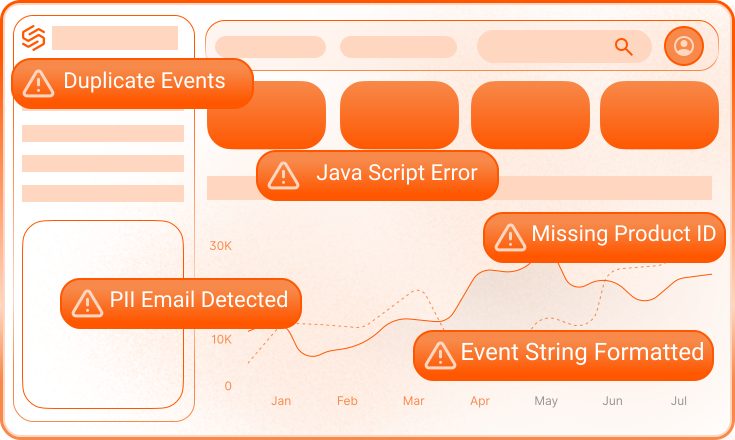
For consent, a CMP is not set-it-and-forget-it, nor will it monitor whether it is honored. Limit your leg
Stay ahead of regulators and plaintiff attorneys by monitoring consent adherence in real-time and remediating known issues quickly with valuable technical insights.
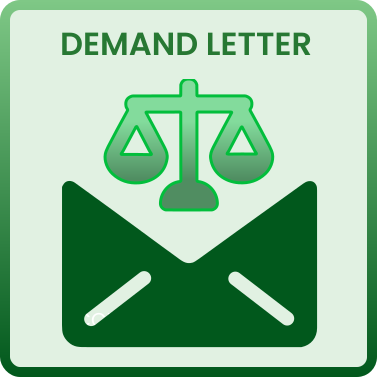
Validate real tag behavior against custom created rules that only apperar in real user behavior and may signal a risk.
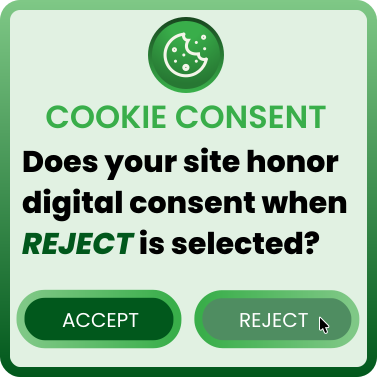
For consent, a CMP is not set-it-and-forget-it, nor will it monitor whether it is honored. Limit your legal, financial, and reputational exposure to privacy + consent lawsuits and regulatory fines by monitoring, flagging, and alerting you to unlawful and unintended data violations taking place on your website.
Stay ahead of regulators and plaintiff attorneys by monitoring consent adherence in real-time and remediating known issues quickly with valuable technical insights.
A national direct-to-consumer food brand operating high-volume B2C and B2B ecommerce sites faced growing pressure on advertising efficiency, campaign attribution, and analytics accuracy. Leadership raised concerns that the numbers driving multi-channel investment decisions could not be trusted, and that this uncertainty was putting significant marketing budgets at risk.
Early validation surfaced concrete impact. Sentinel Insights’ real-time, real user monitoring quickly confirmed that analytics inaccuracy and governance gaps were measurable issues affecting attribution, spend efficiency, and executive confidence.
Key Outcomes
Within just a few weeks after deploying Sentinel Insights, the company established clear, verifiable improvements across analytics accuracy and governance operations:
- Nine unused tags removed from production after being surfaced through real-user validation
- Fifteen major tag update releases executed with continuous oversight, reducing regression risk during rapid change
- 58 percent reduction in unattributed pageviews in Adobe Analytics , improving confidence in campaign attribution and performance reporting
These outcomes confirmed that long-standing analytics inconsistencies and governance gaps were systemic issues affecting budget allocation, optimization decisions, and executive trust in reporting. Sentinel Insights provided the visibility required to identify, validate, and correct these issues in live user environments.
The company faced a fundamental visibility gap. Teams responsible for marketing performance, analytics accuracy, and consent enforcement did not have a reliable way to verify how tags and data behaved in real user sessions. Decisions were being made on top of systems that no one could fully observe or validate at scale.
The MarTech stack spanned Adobe Analytics, Adobe Launch, Facebook / Meta, Google Ads, LinkedIn, and other third-party technologies. Ownership was distributed across marketing, analytics, IT, and brand protection. Each group managed its portion of the stack, but no team had an end-to-end view of how tags fired, what data they transmitted, or how consent states were enforced during actual customer journeys.
Manual processes governed analytics configuration and consent logic, but those controls were designed for setup and documentation, not for validating live behavior. As the site evolved and tag changes accelerated, these processes could not reliably detect misfires, regressions, or vendor-driven changes introduced outside scheduled releases.
Periodic audits and spot checks provided only a snapshot in time. They could not account for dynamic page flows, race conditions, or third-party behavior that varied by browser, region, or consent signal. As a result, issues often surfaced only after downstream effects appeared in reporting or campaign performance.
This created a blind spot across functions. Marketing teams questioned whether performance data could be trusted. Analytics teams suspected structural issues but lacked proof. Legal and risk stakeholders could not independently verify whether consent choices were consistently respected.
These visibility gaps had tangible consequences. Leadership raised concerns that multi-channel investment decisions were being made on analytics data that could not be validated. High-spend campaigns underperformed despite apparently strong reporting, and teams lacked confidence in attribution signals.
For this organization, analytics data quality and consent governance were inseparable. When tags fired against the wrong consent state or data layer values shifted unpredictably, both compliance posture and optimization accuracy deteriorated at the same time. Without a way to observe and verify live tracking behavior, the company faced growing financial risk, operational inefficiency, and governance exposure.
Sentinel Insights was deployed to establish a factual baseline of how tags and data behaved in real user sessions. This deployment provided the evidence layer used to identify the findings outlined below.
Sentinel evaluated each tag against best practices, a tailored list of prioritized conditions, and the user’s recorded consent state and verified:
Sentinel was configured to ignore traffic from internal testers and automated bots so the customer only saw real user behavior. This prevented the dashboard from showing false issues or irrelevant tag activity, which made it easier for teams to identify genuine problems.
The company incorporated Sentinel findings into its brand protection council and cross-functional processes. This gave the new analytics leader and other stakeholders unbiased evidence of how the site behaved in real time and supported faster remediation across teams.
Sentinel confirmed the core issues that the analytics team had long suspected:
One stakeholder described the impact.
“You could see the pageviews come through ten times. The numbers were way off.”
For the new analytics leader, this reinforced concerns that the organization had been optimizing campaigns against flawed data and wasting budget on underperforming tactics. Sentinel findings also surfaced legacy and unused scripts contributing to this noise, enabling the team to remove nine unnecessary tags and reduce the likelihood of future attribution regressions.
Sentinel revealed what was really happening with consent enforcement:
As one team member put it:
“The consent gaps lit up like a Christmas tree.”
Sentinel detected email addresses and other identifiers appearing in referrer URLs due to external redirect behavior. This not only created potential exposure but also affected trust in upstream and downstream data flows.
Marketing, analytics, IT, and brand protection all contributed to governance, but none had a real-time view of what occurred in live browser sessions. Periodic audits could not detect regressions introduced by vendor updates, new tags, or rapid changes in campaign logic.
A risk owner summarized the need for clarity.
“The dashboard gives us visibility from the outside in.”
These limitations created uncertainty, inefficiency, and avoidable financial impact, especially in paid media and campaign optimization. The company needed a continuous validation layer, not another static audit.
Sentinel Insights provided continuous visibility into live tracking behavior, enabling the company to correct long-standing issues, restore trust in analytics, and strengthen governance across teams.
Sentinel findings enabled teams to identify and correct missing source variables, unstable purchase events, and data layer behavior that caused fluctuating values mid-page. As these issues were resolved, attribution signals stabilized and unattributed traffic in Adobe Analytics declined materially.
For teams making daily optimization decisions, this clarity reduced the risk of misallocating spend based on unreliable data.
Continuous validation surfaced gaps in how marketing technologies responded to user consent signals. Sentinel also flagged instances of sensitive data appearing in analytics payloads, which the company traced to an external redirect pattern and resolved quickly.
These findings improved confidence that consent enforcement and data flows aligned with internal expectations, while reducing downstream exposure risk.
Legal, risk, analytics, IT, and marketing teams adopted Sentinel Insights as a shared source of truth for understanding live site behavior.
“We are setting the foundation. Sentinel Insights is our cement truck.”
With a consistent, evidence-based view of tracking behavior, leadership gained greater confidence in internal reporting, audit preparation, and cross-functional decision-making.
Moving beyond visibility to decision-making confidence
With continuous visibility into live tracking behavior, the company moved away from assumption-based oversight toward verifiable, production-level control. Teams no longer relied on periodic audits or inferred behavior. They validated issues as they occurred, using factual evidence from real user sessions.
This shift strengthened analytics accuracy, reduced consent-related exposure, and improved cross-functional alignment. Legal, risk, analytics, IT, and marketing teams operated from a shared source of truth, which supported clearer decision-making and greater executive confidence.
As the organization continues to mature its governance program, Sentinel Insights remains embedded as a continuous validation layer across its ecommerce environment. The company is focused on maintaining data quality, reducing legacy complexity, and integrating real-user findings into ongoing privacy and marketing operations.
Organizations facing similar challenges often assume their tracking behaves as expected. Sentinel Insights makes it possible to verify that assumption with evidence.
The post How a Leading DTC Brand Restored Analytics Data Quality With Real-Time Validation appeared first on Sentinel Insights.









01
One tag from Sentinel Insights is all it takes to start identifying consent b242769a on your website.
02
We implement and set up your tailored solution and dashboard in just one day.
03
Sentinel Insights helps legal, IT, and marketing departments work together and make sure you are in compliance.
Our platform monitors real user data in real time for issues with consent, privacy and data quality.
Sentinel Insights supports privacy regulations that require proof of runtime consent enforcement, not just documentation.
Our platform monitors for laws where compliance depends on how tags, signals like GPC, and third-party data flows behave in live user sessions, supported by timestamped, production-level evidence. Sentinel is regulation-agnostic because regulators ultimately ask the same question: when a user made a choice, what actually happened?
Sentinel Insights evaluates websites by observing live behavior to see how tags, third-party requests, and data flows actually execute for real users under different consent states.
This execution-level approach surfaces enforcement failures that static methods miss and preserves each event as timestamped evidence showing what ran, when, and under which conditions. A user can log into the dashboard for information or set up custom rules and alert thresholds for proactive management of consent, privacy and data quality.
Sentinel Insights closes the governance gap by validating what actually happens around real user behavior for consent, privacy and data quality.
There are many different use cases, so here are just a few examples: managing privacy and compliance regulations like CCPA and GDPR, supporting martech migrations from a new tag management solution/analytics/CDP, replace annual audit with real time monitoring, hundreds of hours saved for QA each year.
Sentinel Insights monitors consent signals and data governance anomalies, while SentinelOne provides endpoint detection and response for cybersecurity threats. One focuses on privacy and compliance intelligence; the other focuses on threat prevention and incident response. We are completely separate companies.
Questions?
Consent Monitoring
Guard against consent & privacy lawsuits
Save thousands of hours in manual efforts
Avoid financial & reputational loss
Consent mapping for every tag
Monitor 100% of user consent in real-time
Why do you need real-time consent monitoring vs. auditing
DATA INSIGHTS
WHITE PAPERS