The Martech for 2026 report outlines a near future where AI agents sit at the center of marketing operations. Decisioning, orchestration, and optimization increasingly rely on machine-driven systems that act in real time, across channels, and at scale.

What the report makes equally clear is that progress is constrained less by ambition than by fundamentals. AI performance rises or falls based on the quality, structure, and trustworthiness of the data it consumes. When governance is weak, AI does not fail quietly. It produces confident outputs based on incomplete or unreliable inputs.

For enterprise teams, the question is: can we trust, validate, and govern data across systems that were never designed to operate autonomously?

Data Quality Is the Constraint on AI Performance

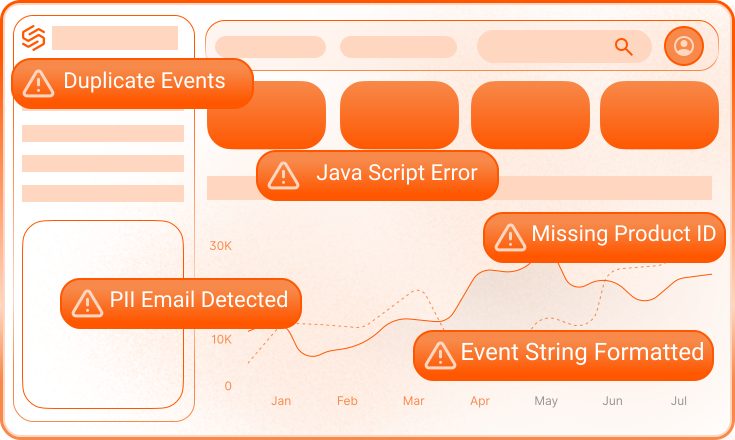
Survey findings in Martech for 2026 point to a consistent obstacle. Data quality remains the most significant barrier to effective AI deployment. Respondents cite missing attributes, inconsistent identifiers, outdated records, and disconnected systems as persistent challenges that limit automation and personalization outcomes.

These issues compound quickly in AI-driven environments. Models trained on flawed inputs replicate those flaws at scale. Recommendation engines optimize against incomplete signals. Attribution systems reinforce inaccurate assumptions. Over time, teams lose confidence in outputs they cannot explain or verify.

This erosion of trust has operational consequences. Marketing teams hesitate to rely on AI-driven decisions. Legal and privacy teams question whether data use aligns with stated policies. Technical teams spend increasing time troubleshooting downstream effects instead of improving systems upstream.

Data quality problems are governance problems. They reflect a lack of shared standards, validation, and accountability across the martech ecosystem.

Governance Provides Context, Not Just Control

The report highlights a shift toward context-driven AI systems. These systems depend on more than raw behavioral data. They rely on signals such as customer status, geography, device, intent, and consent to determine appropriate actions in real time.

Context only works when it is accurate and enforced consistently. Governance enables that consistency by establishing clear rules around how data is collected, classified, validated, and activated.

Effective governance supports AI by ensuring:

  • Data remains accurate, current, and traceable across systems.
  • Consent signals are preserved and enforced as data moves through the stack.
  • Definitions and schemas remain consistent across platforms and vendors.
  • Decisions can be reviewed, explained, and audited when questions arise.

Without these controls, AI systems operate with partial context. That creates risk, not efficiency.

The Factory and the Laboratory Need Shared Standards

One of the more practical frameworks in Martech for 2026 is the distinction between production systems and experimental environments. Innovation depends on both. So does discipline.

Production systems require reliability, repeatability, and defensibility. Experimental environments require flexibility and speed. Governance is what allows these modes to coexist without undermining each other.

When governance is absent, experiments leak into production. Test data contaminates live workflows. New tools bypass existing controls. Over time, the martech stack becomes harder to understand and harder to defend.

Clear governance establishes promotion criteria. It defines what data quality thresholds must be met before AI systems influence customer experiences. It also provides guardrails that allow experimentation without introducing unmanaged risk.

Consent Validation Is Part of Data Quality

Consent is often treated as a compliance artifact that lives outside core data systems. In AI-driven martech, that separation no longer holds.

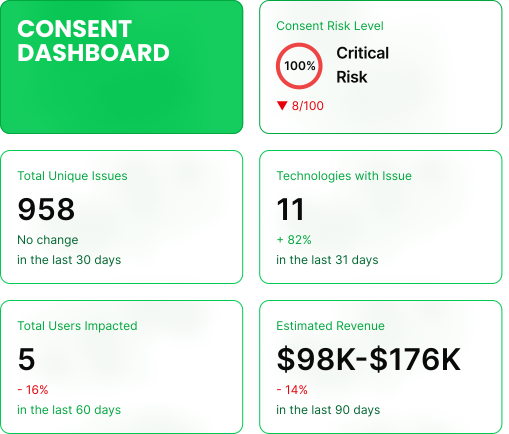
Consent signals directly affect which data can be used, how it can be combined, and where it can be activated. If consent metadata is incomplete, outdated, or inconsistently enforced, downstream AI systems operate on assumptions rather than verified permissions.

This creates two problems. First, it introduces regulatory exposure when data is used beyond what a user has allowed. Second, it undermines data quality by allowing AI systems to reason over data that should not have been available in the first place.

Governance frameworks that include consent validation treat permission data as foundational. Consent signals move with user data. Enforcement is observable. Gaps are identified before they propagate across systems.

Governance Turns AI From Risk Multiplier Into Asset

The promise of AI-driven martech is operational leverage. Fewer manual decisions. Faster execution. More relevant customer experiences. That promise only holds when organizations trust the systems making those decisions.

Trust comes from visibility and validation. Teams need to know what data is being used, where it originated, and whether it aligns with internal standards and external obligations. Governance provides that clarity.

Organizations that invest in governance see practical benefits:

  • Greater confidence in automated decisioning.
  • Fewer downstream corrections and rework.
  • Stronger alignment between marketing, legal, and technical teams.
  • Reduced exposure tied to consent and data misuse.

AI does not replace accountability. It increases the need for it.

Conclusion

The future described in Martech for 2026 is achievable. AI agents can coordinate complex ecosystems and respond to customer signals at scale. That future depends on foundations that many organizations have postponed building.

Data quality, consent validation, and governance are not secondary concerns. They determine whether AI amplifies value or accelerates failure. Enterprises that prioritize governance now will be positioned to deploy AI with confidence, credibility, and control.

For AI-driven martech, governance is not overhead. It is the operating system.